An air fryer is often described as a small convection oven. That comparison is useful, but incomplete. Both move hot air around food, yet chamber size, fan placement, airflow intensity and distance from the heating element can all change how quickly food cooks and browns.
That is why copying the same oven temperature and cooking time into an air fryer does not always give the same result.
Need the calculation, not the explanation? Open the Air Fryer Conversion Calculator →
Conventional oven, convection oven and air fryer are not the same thing
A conventional oven heats the cooking chamber without deliberately circulating the air with a fan. Heat reaches the food through hot air, the heated oven surfaces and the heating elements.
A convection oven adds a fan. Moving air continually replaces the cooler layer of air around the food with hotter air from the oven, changing the way heat is transferred and often making cooking more even.
An air fryer uses the same broad principle — moving hot air — but usually in a much smaller chamber, with the food closer to the heating system and a strong fan directing air around it. That more concentrated environment is one reason smaller portions can cook and brown quickly.
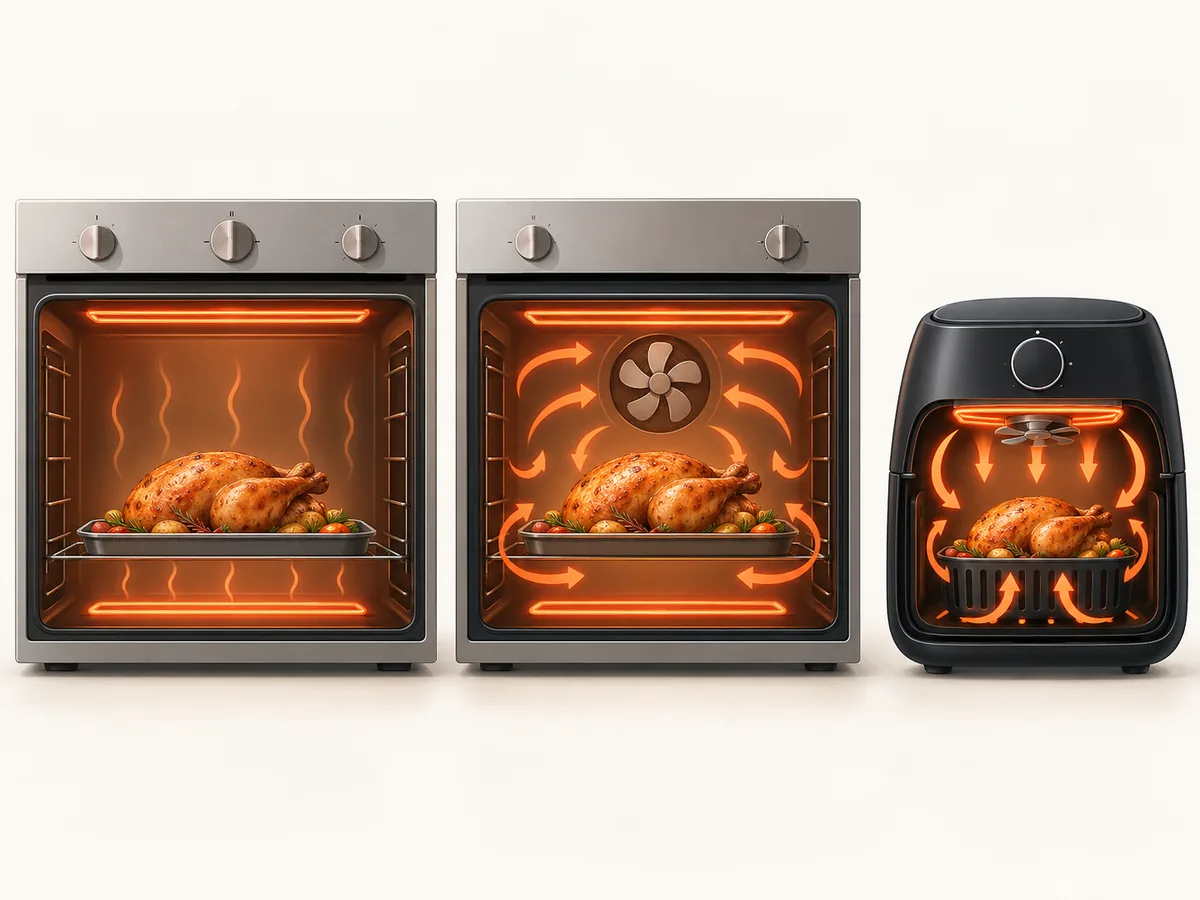
Why the original oven type matters
A recipe written for a conventional oven starts from different conditions than one written for a fan or convection oven. If the recipe already assumes moving hot air, part of the difference between oven cooking and air frying is already present. If it assumes a conventional oven, the change can be larger.
That is why Panmetry asks for the source oven type even in the basic calculation. It is not an extra question for the sake of complexity; it changes the starting point of the conversion.
Why one fixed conversion rule is only a shortcut
Quick rules are easy to remember. The problem begins when the same temperature reduction and the same time reduction are applied to every recipe.
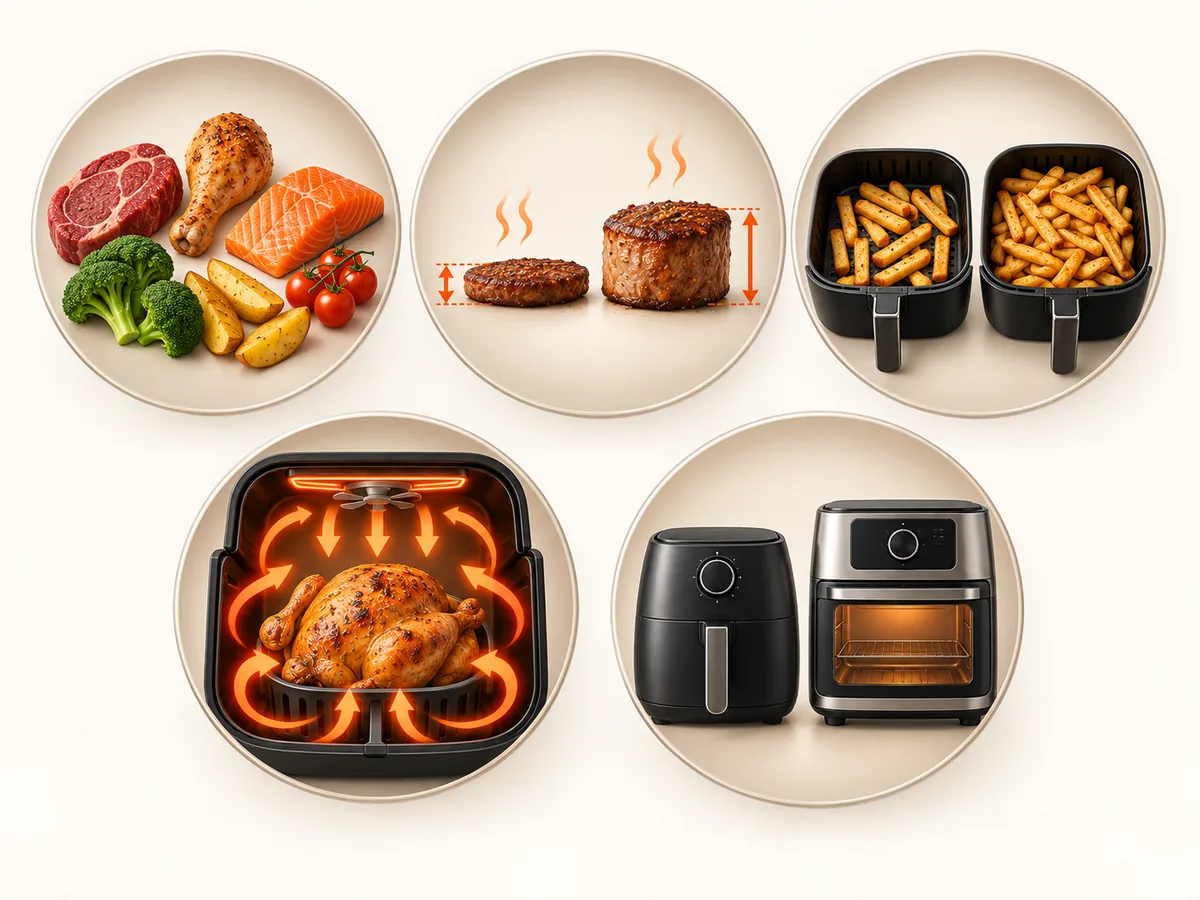
A tray of vegetables, a thick piece of meat, a whole potato and a deep cake do not respond to heat and airflow in the same way. A fixed percentage can be a useful starting point, but it should not be mistaken for a universal cooking law.
Why air-fryer cooking time is often shorter
An air fryer does not magically make every food cook faster. What it changes is the way heat reaches the food.
Small pieces arranged in a loose layer expose a large surface area to rapidly moving hot air. That can accelerate surface heating and browning. The advantage becomes smaller when the basket is crowded, the food is thick, the product sits inside a deep pan, or airflow is restricted.
Food type changes the conversion
Two recipes can both say 200°C for 30 minutes and still need very different adjustments in an air fryer.
Thin vegetables react quickly to moving hot air. A whole potato has to heat through to the centre. A thick piece of meat is limited by how quickly heat travels inward. Cake batter inside a pan is exposed to airflow very differently from fries sitting directly in a perforated basket.
Basket load matters more than it looks
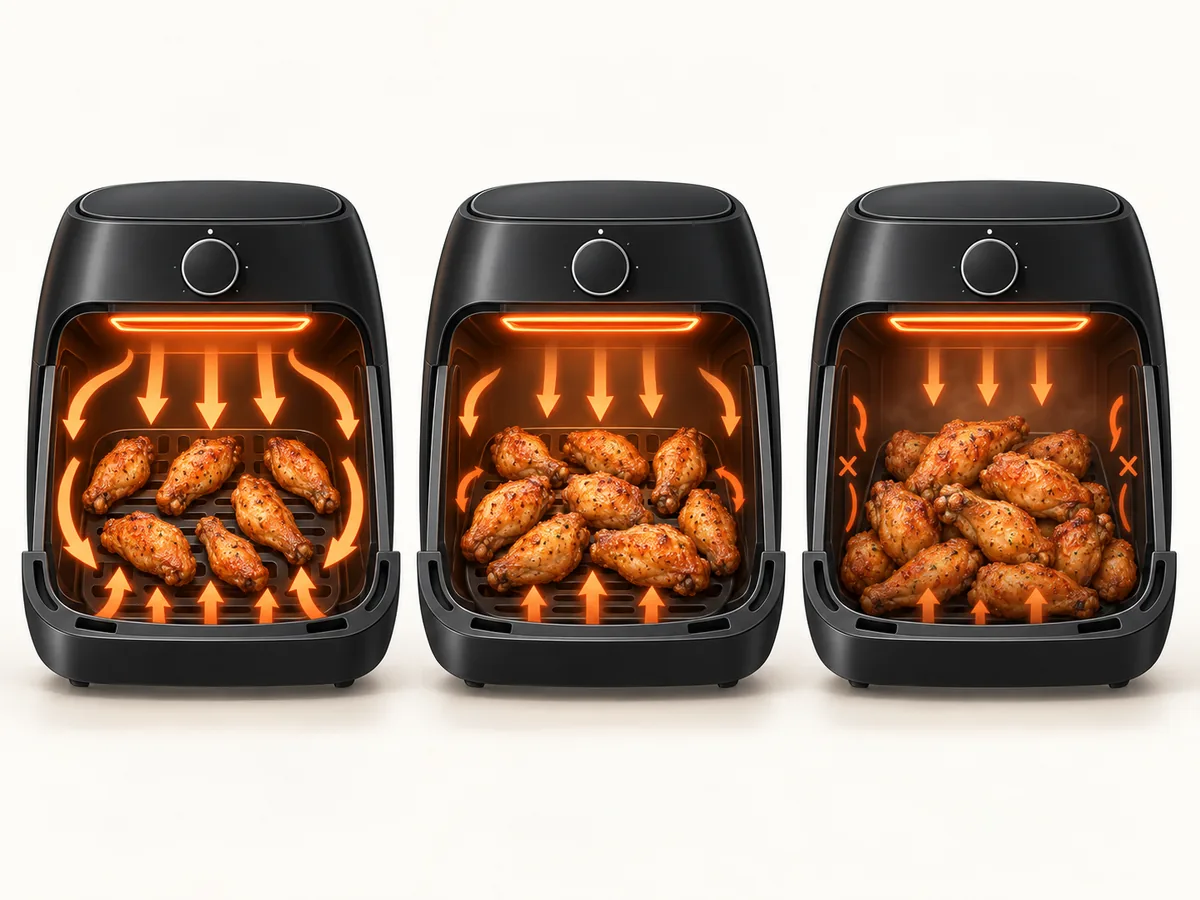
Air fryers work best when hot air can move around the food. A loose single layer, a tightly packed single layer and several overlapping layers are not equivalent cooking conditions.
As the basket gets fuller, airflow between pieces becomes more restricted. That can slow cooking, make browning less even and push the real cooking time further away from a simple baseline estimate.
Temperature and time affect each other
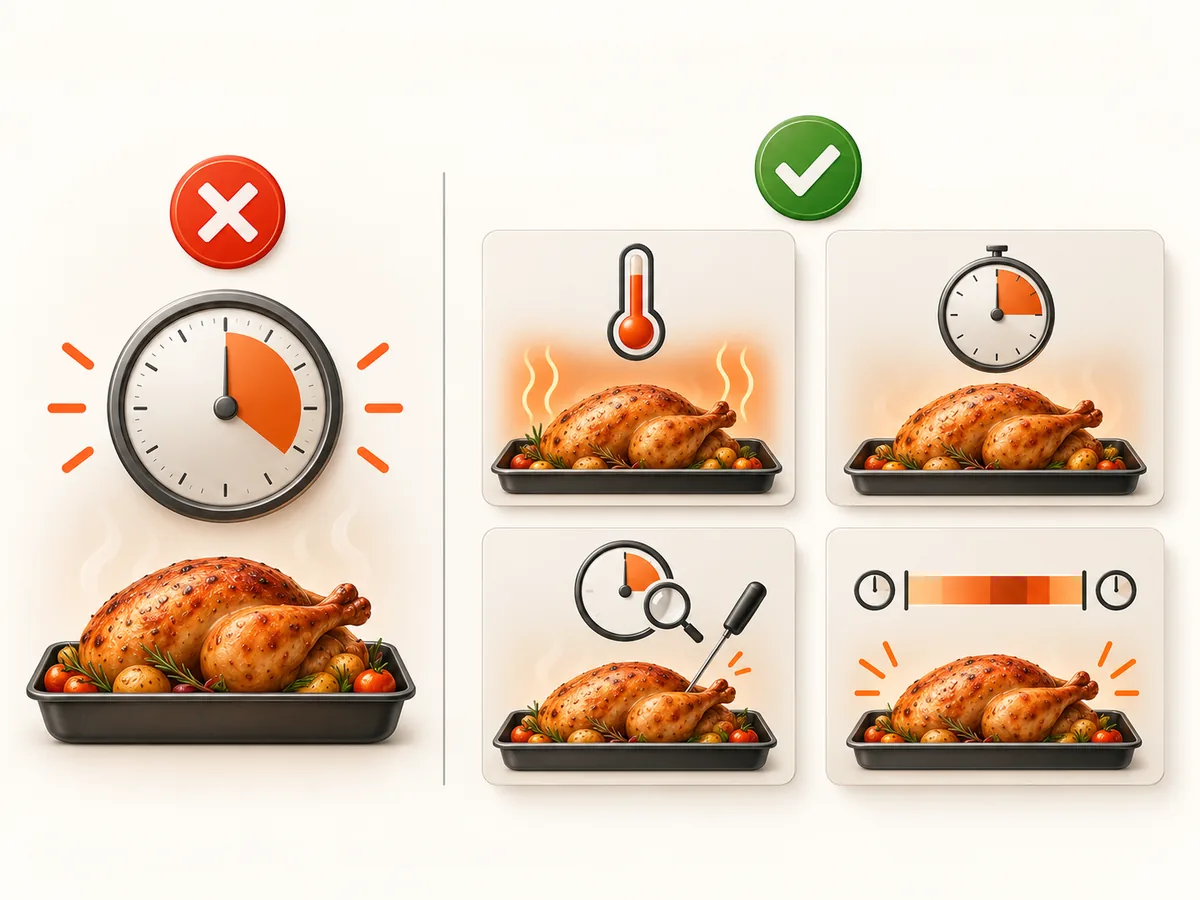
Temperature and cooking time are not independent settings. If the air-fryer temperature is reduced, the cooking-time reduction cannot automatically be treated as if the temperature had stayed unchanged. Likewise, raising the temperature may brown the outside faster without heating the centre of a thick food at the same rate.
That is why Panmetry treats time and temperature as connected parts of the same conversion instead of two unrelated adjustments.
Why Panmetry shows a time range, not just one number
Even a careful conversion cannot know every detail of a real kitchen. Different air fryers can move air differently. Food thickness varies. Starting temperature varies. Basket loading varies.
So a single result such as “18 minutes” can imply more certainty than actually exists. Panmetry instead gives four useful reference points: recommended temperature, recommended cooking time, when to start checking, and an expected time range.
What if my full-size oven has an Air Fry mode?
An Air Fry setting can make a full-size oven behave more like an air fryer, usually through stronger convection. But the larger cooking cavity still changes the airflow. So the name of the mode alone is not enough to know how much time or temperature should change for every appliance.
Can an oven recipe be converted accurately for an air fryer?
Yes — but a useful conversion is better treated as an estimate based on known cooking conditions than as a single universal formula.
For a quick calculation, you only need the recipe temperature, cooking time and source oven type. For a more precise estimate, Panmetry can also use details such as food type, basket loading, appliance style, food thickness, preheating, starting state and airflow restrictions.
Convert your oven recipe for an air fryer →
Sources
- Good Housekeeping Institute — Air Fryer vs. Convection Oven
- Campden BRI — Heating characteristics of domestic air fryers
- King Arthur Baking — Air fryer baking guidance